
Executive Summary & Key Takeaways
- Spirits and wine require a multi-stage approach to eliminate barrel char, colloidal haze, and spoilage microbes without stripping authentic aromatic congeners and color.
- Chill haze clarification using lenticular depth filter modules removes fatty acid ethyl esters (palmitate, oleate) that cause cloudiness when chilled on ice.
- Pre-bottling absolute 0.45 µm membrane filtration provides microbiological stability against yeast (*Brettanomyces*) and acetic/lactic acid bacteria without chemical preservatives.
1. The Science in the Glass: Why Filtration Actually Matters
Raw distillate fresh from a copper pot still is not a finished, shelf-stable spirit. Even after maturing for years inside charred American oak casks or French oak barrels, a premium spirit or wine carries suspended wood particles, carbon flakes, polymerized tannins, and microscopic colloidal compounds.
When consumers pour whisky or spirits over ice, or hold a glass of white wine up to the light, they demand brilliant optical clarity. If the liquid turns murky or throws sediment in the bottle, customer trust is lost. Yet, aggressive or improper filtration can strip away the delicate long-chain aromatic esters, lactones, and phenolic congeners that give aged spirits their distinctive body and depth. The secret to master distilling lies in precision, staged filtration.
"Filtration in distilleries and wineries is not about sterile destruction; it is an art of selective extraction. The objective is removing visually unappealing particulates, char, and spoilage yeasts while leaving authentic flavor congeners completely intact."
2. The Four Stages of the Distillery & Winery Process
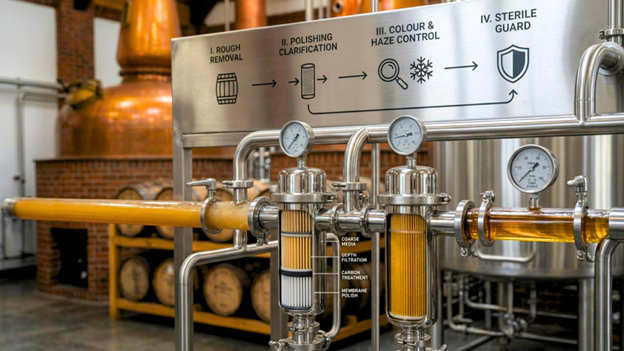
Modern commercial distilleries and boutique wineries rely on a sequence of four engineered filtration stages:
Stage 1: Coarse Filtration & Wash Clarification
The initial pass removes large visible solids, grain fragments from the mash tun, and debris before distillation or primary aging. High dirt-capacity bag filters (25 µm to 100 µm) or stainless steel basket strainers protect distillation column trays, plate reboilers, and transfer pumps.
Stage 2: Barrel Char Removal Post-Aging
During the maturation of bourbons, rums, and whiskies, the charred interior surface of oak casks flakes off. When barrels are dumped, the spirit contains high levels of carbon charcoal flakes and heavy particulate. Sizing a dual-stage roughing filter (10 µm to 25 µm polypropylene felt bag or high-flow depth cartridge) captures carbon debris without clogging downstream polishing filters.
Stage 3: Chill Haze Removal & Clarification
Spirits contain high concentrations of long-chain fatty acid ethyl esters (such as ethyl palmitate, ethyl stearate, and ethyl oleate) dissolved in high-proof ethanol (60-65% ABV). When the spirit is diluted with demineralized water down to bottling strength (40-43% ABV) and served cold or on the rocks, these esters become insoluble, creating an unsightly milky haze known as chill haze.
- Chill Filtration Process: The spirit is chilled to temperatures between -2°C and 4°C for 24 to 48 hours to deliberately force ester agglomeration.
- Lenticular Depth Module Separation: The cold spirit is pumped through Charge-Plus Lenticular Depth Filter Modules. The positively charged cellulose/kieselguhr matrix adsorbs sub-micron colloidal ester droplets via electrokinetic attraction without stripping flavor congeners.
Stage 4: Final Pre-Bottling Sterile Polishing
Prior to packaging into bottles, cans, or kegs, the beverage passes through a final guard membrane to ensure microbiological stabilization:
- For Wines: Validated 0.45 µm hydrophilic PES membrane cartridges (such as SteriPro PE) capture spoilage yeast (Brettanomyces, Saccharomyces) and bacteria (Lactobacillus, Pediococcus, Acetobacter), guaranteeing biological stability without sorbates or excessive sulfur dioxide (SO2).
- For High-Proof Spirits: High-purity 1.0 µm pleated polypropylene absolute cartridges eliminate any airborne dust, bottle rinse droplets, or micro-particulates, delivering a radiant, diamond-bright sheen.
3. Sanitary Housing & Operational Compliance
Beverage contact vessels must meet strict hygienic engineering guidelines:
- Material of Construction: Sanitary SS 316L with internal surface electropolish Ra ≤ 0.4 µm to eliminate bacterial attachment sites.
- Zero Dead-Legs & Total Drainability: Vessels must feature inverted dome bases with sanitary tri-clamp drain connections for 100% gravity evacuation during Clean-In-Place (CIP).
- Sanitary Gas & Vent Filtration: Storage and bottling balance tanks must be protected with hydrophobic PTFE 0.2 µm sterile vent filters to prevent airborne bacterial suction during liquid draw-down.