
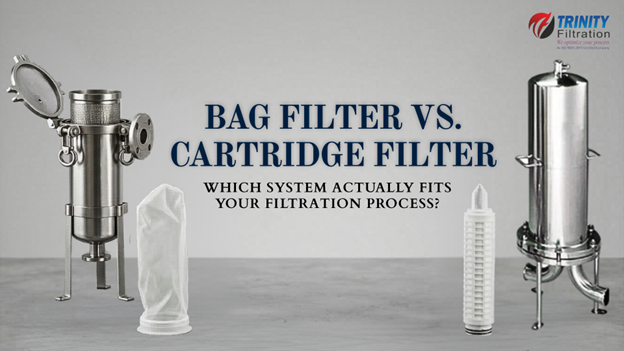
Executive Summary & Key Takeaways
- Bag filters are the industrial "heavy lifters", capturing bulk dirt loads from 1 to 1,000 microns at flow rates up to 1,000+ GPM with lower initial capital cost.
- Cartridge filters are the "precision specialists", providing high efficiency from 0.1 to 100 microns with absolute ratings (Beta ≥ 5000) for critical process streams.
- For high solid loads (> 50-100 ppm) or large batches, bag filters provide economical bulk pre-filtration; for fine polishing and regulatory compliance, cartridges are essential.
- The optimal engineering architecture often pairs both: bag filters as stage 1 roughing filters protecting downstream precision cartridges.
1. The Industrial Debate: Heavy Lifters vs. Precision Specialists
In any industrial facility, filtration is not just a "nice-to-have" auxiliary step; it is the protective shield defending high-pressure pumps, expensive spray nozzles, sensitive heat exchangers, and the final integrity of your commercial product. Whether refining edible oils, running automotive e-coat paint lines, processing specialty resins, or purifying boiler feedwater, solids separation is mandatory.
This brings chemical engineers and plant operators to the classic dilemma: Bag Filters or Cartridge Filters? For many plant managers and procurement leads, both appear to perform a similar function: liquid enters a pressurized vessel, passes through porous media, and leaves suspended particulate matter behind. However, operating physics, media mechanics, and operational cost curves between the two systems are vastly different.
"If your primary challenge is managing high solid volumes and bulk debris at high flow rates, bag filters are your heavy lifters. If your challenge is sharp cut-off efficiency, sub-micron clarity, and sterile biological control, cartridge filters are your precision specialists."
2. Understanding Bag Filters: The Industrial "Heavy Lifters"
Bag filters are the backbone of bulk industrial solids separation. The operating principle is straightforward and exceptionally robust: fluid enters through the top inlet of the housing, flows directly into the interior cavity of the filter bag supported by an internal perforated stainless steel basket, and permeates through the felt or mesh walls from the inside-to-outside.
Key Design Characteristics
- Trapping Dirt Inside: Because liquid flows from inside to outside, all captured solids, sludge, and contaminants collect neatly inside the bag interior. When changing the element, the operator lifts out the bag and all dirt is removed cleanly without contaminating the vessel interior.
- Standard Industry Sizing: Standard industrial bag filter housings utilize standardized bag sizes:
- Size 1: 7" diameter × 16" length (Surface area ~0.25 m², flow rates up to 20 m³/hr)
- Size 2: 7" diameter × 32" length (Surface area ~0.50 m², flow rates up to 40 - 50 m³/hr per single bag)
- Size 3 & 4: Compact point-of-use units (4" diameter × 8" or 14" length)
- Media Varieties: Needle felt polypropylene (PP), polyester (PE), nylon monofilament (NMO) mesh, and specialized multi-layer oil-absorbent meltblown microfibers.
Primary Operational Advantages
- High Dirt-Holding Capacity: Filter bags handle significant cake buildup and gelatinous agglomerates without immediate blinding.
- Rapid, Tool-Free Changeouts: Opening an eye-bolt or quick-clamp housing lid allows bag replacement in under 3 minutes, minimizing process downtime.
- Low Initial Capital Expenditure (CapEx): Single and multi-bag vessels provide massive flow capacity with smaller vessel footprints and lower initial capital cost than large multi-cartridge vessels.
3. Understanding Cartridge Filters: The "Precision Specialists"
While bag filters conquer high-volume dirt loads, cartridge filters take over when downstream specifications demand uncompromising purity, sharp particle size cut-offs, and sub-micron retention.
Cartridge filters generally operate with an outside-to-inside flow geometry (or inside-to-outside in modern 6-inch High Flow designs). Fluid passes through multiple cylindrical elements mounted inside a pressure vessel, depositing particulates across pleated surface layers or throughout the graded-density depth matrix.
Depth vs. Surface Filtration Mechanics
Cartridges come in two primary mechanical configurations:
- Depth Filtration (Spun-Bonded & Wound Elements): Graded density pore structures where larger particles are trapped on outer layers, while progressively smaller particulates penetrate deeper into the core. Ideal for broad particle size distributions and deformable particles.
- Surface & Pleated Filtration: High-surface-area pleated membrane or microglass sheets offering up to 0.7 m² of filtration area per 10-inch length. Pleating delivers exceptionally low clean differential pressure (ΔP) and true absolute retention ratings (Beta Ratio β ≥ 5000 / 99.98% efficiency).
4. Direct Head-to-Head Engineering Comparison
The table below summarizes the key operational, mechanical, and economic differences between bag and cartridge systems:
| Performance Metric | Industrial Bag Filter Systems | Precision Cartridge Filter Systems |
|---|---|---|
| Micron Rating Range | 1 µm to 1,000 µm (typically 5 µm – 200 µm) | 0.1 µm to 100 µm (sub-micron sterile grades available) |
| Filtration Rating Type | Predominantly Nominal (60% – 85% retention) | Nominal and Absolute (up to 99.98% / Beta ≥ 5000) |
| Dirt Holding Capacity | Very High (up to 2 – 5 kg per Size 2 bag) | Moderate per 10" element; High in 6" High Flow |
| Initial Capital Cost (CapEx) | Lower initial vessel and installation cost | Moderate to higher depending on vessel round count |
| Element Replacement Cost | Economical per changeout cycle | Higher unit cost, balanced by longer lifecycles |
| Fluid Viscosity Handling | Exceptional (adhesives, paints, syrups, resins) | Requires oversized surface area for viscous fluids |
| Maintenance Downtime | Fast changeout (2–5 minutes per vessel) | Moderate (requires removing tie-rods and springs) |
| Sanitary / Sterile Suitability | Limited; industrial and food-grade coarse utility | Mandatory for bio-pharma, sterile water, microelectronics |
5. Decision Matrix: Which System Does Your Plant Need?
To determine the optimal system for your application, answer these four diagnostic engineering questions:
- What is the concentration of suspended solids?
If your stream contains high solid loads (> 50–100 ppm) with variable particle sizes, starting directly with cartridge filters will lead to premature blinding and exorbitant replacement costs. A bag filter is strongly recommended. - What is the required downstream particle cut-off?
If your downstream process involves reverse osmosis membranes, UV reactors, sterile drug filling, or electronic cleanroom washing requiring < 1 µm absolute retention, cartridge filters are mandatory. - What is the fluid viscosity?
Heavy paints, raw resins, varnishes, and polymers flow more easily through bag filters under standard operating pressures without excessive differential pressure drop. - Is the system continuous or batch?
For short batch operations with high cleanout turnover, bag filters minimize product hold-up volume and media waste.
6. The Optimal Architecture: Staged Synergy
In modern world-class chemical and manufacturing facilities, engineers rarely choose between bags and cartridges as mutually exclusive options. Instead, they leverage the Staged Filtration Architecture:
- Stage 1 (Roughing & Protection): A Trinity MAX-FLO Bag Filter Housing equipped with Flow Pure needle felt bags intercepts pipe scale, pump debris, and bulk contaminants down to 25 µm.
- Stage 2 (Intermediate Polishing): High Flow or Spun-Bond depth cartridges capture fine silt and deformable particles down to 5 µm.
- Stage 3 (Final Critical Guard): Pleated absolute polypropylene or SteriPro PES membrane cartridges deliver crystal-clear, validated product polishing.
This staged approach extends the operating lifecycle of expensive absolute cartridges by 400% to 600%, slashing overall plant operating costs while guaranteeing flawless quality.