

Executive Summary & Key Takeaways
- Process filtration is vital for protecting high-pressure pumps and spray nozzles, ensuring uniform batch quality, and meeting strict EPA/FDA regulations.
- Sizing must evaluate four core pillars: fluid chemistry & compatibility, particulate characteristics, operating pressure & temperature, and allowable clean differential pressure (ΔP).
- Common selection mistakes include selecting nominal filters for sterile processes, undersizing surface area resulting in rapid fouling, and ignoring fluid viscosity scaling factors.
1. Why Industrial Process Filtration Matters
In the high-stakes world of large-scale manufacturing and chemical processing, purity is never just an aesthetic preference; it is an uncompromising operational requirement. Whether managing a petrochemical refining loop, high-speed beverage bottling line, pharmaceutical API reaction, or semiconductor chip fabrication facility, unmanaged contaminants cause immediate financial damage.
"Implementing an engineered, properly sized filtration setup is a strategic capital investment in plant availability. It prevents unscheduled shutdowns, protects multi-million dollar rotating assets, and guarantees batch-to-batch repeatability."
Core Drivers of Process Filtration
- Equipment Protection: Downstream components such as high-pressure positive displacement pumps, precision spray nozzles, RO membrane modules, and plate-and-frame heat exchangers are vulnerable to erosion and clogging from suspended solids. Effective pre-filtration eliminates catastrophic asset failure.
- Product Quality: In sectors like food and beverage, fine chemicals, and automotive coatings, even microscopic particles result in product haziness, surface defects (fish-eyes, craters), and failed QA batch inspections.
- Process Efficiency: A properly sized filtration skid prevents premature pressure spikes, optimizes flow rates across heat transfer units, and drastically reduces unscheduled maintenance downtime.
- Regulatory & Environmental Compliance: Strict environmental discharge norms (EPA, pollution control boards) and statutory safety standards (FDA, cGMP, ASME BPE) mandate rigorous fluid particulate separation prior to discharge or human consumption.
2. Key Factors When Choosing a Filtration Assembly
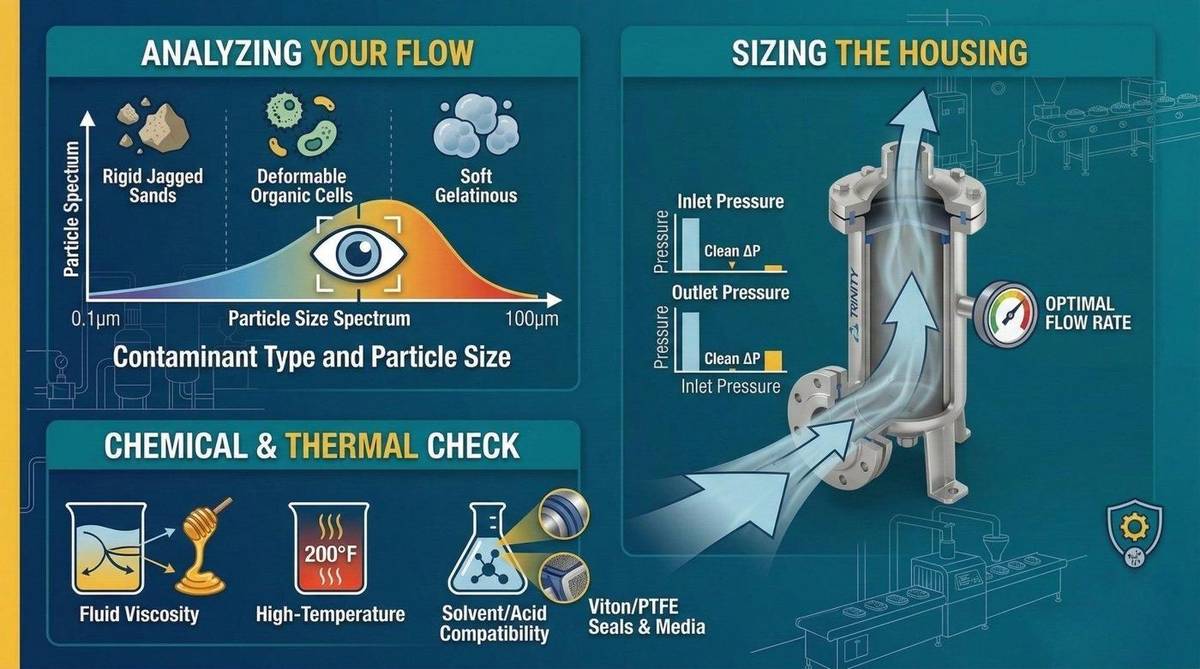
Selecting the optimal filter requires an exhaustive audit of your process parameters. Plant engineers should evaluate these four foundational pillars:
1. Fluid Chemistry and Chemical Compatibility
The chemical composition of your process liquid dictates the required media material and elastomer seals:
- Aqueous & General Fluids: Polypropylene (PP) provides wide chemical resistance and economical performance for water, mild acids, and bases.
- High-Temperature & Aggressive Solvents: Fluoropolymers like PTFE, PVDF, or all-welded Sintered Stainless Steel 316L / Hastelloy are required for hot aromatics, ketones, and concentrated acids.
- Seal Selection: Ensure O-rings and gaskets match fluid properties (EPDM for polar fluids and steam; Viton/FKM for hydrocarbon oils; Encapsulated PTFE for aggressive mixed solvents).
2. Particulate Characterization & Particle Size Distribution (PSD)
It is not enough to ask for a "5-micron filter." You must understand what type of particulate exists in your fluid:
- Rigid vs Deformable Solids: Hard crystalline solids (sand, rust, catalyst fines) form porous, permeable filter cakes. Gelatinous or deformable contaminants (tannins, unreacted polymers, bio-slime) blind surface membranes rapidly and require graded-density depth cartridges.
- Particulate Loading (ppm or mg/L): High solids concentration (> 100 ppm) mandates strainers or bag filters ahead of precision pleated elements.
3. Operating Flow Rate, Pressure & Temperature
- Clean Differential Pressure (ΔP): Filtration vessels should always be sized so that the initial clean ΔP across new filter elements does not exceed 0.10 to 0.15 bar (1.5 to 2.2 psi). High starting pressure leaves zero buffer for contaminant holding.
- Terminal Differential Pressure: Elements should be changed out when ΔP reaches 1.5 to 2.0 bar (22 to 30 psi) to avoid media distortion, bypass, or structural collapse.
- Operating Temperature: High temperatures reduce the structural burst strength of thermoplastic polymers (PP is limited to ~80°C), requiring metallic or fiberglass alternatives for high-temperature duties.
4. Viscosity Scaling
According to Darcy’s Law for flow through porous media, pressure drop increases linearly with dynamic viscosity. A liquid with a viscosity of 500 cPs (such as lube oil or liquid sugar) exhibits 500 times the flow resistance of water at 1 cP. Failing to derate flow rates for viscous fluids is the #1 cause of undersized filter installations.
3. Industry-at-a-Glance Technology Matrix
| Industry Sector | Typical Fluid Stream | Primary Challenge | Recommended Technology |
|---|---|---|---|
| Automotive Painting | CED E-Coat Paint, DI Water | Paint cratering, conductivity imbalance | Anode Cells, Pure-GUARD Bi-Component, Flow Pure Bags |
| Breweries & Distilleries | Wort, Beer, Spirits, Syrups | Yeast removal, chill haze, biological stabilization | Charge-Plus Lenticular, SteriPro PE 0.45µm PES, Vent Housings |
| Chemical & Petrochemical | Solvents, Acids, Slurries | High temperature, corrosive attack, catalyst loss | Meta-PORE Sintered SS316L, MAX-FLO Industrial Housings |
| Power & Steel Turbines | Turbine & Hydraulic Lube Oils | Dissolved water, varnish, wear metals | Vacuum Oil Purifier Skids, Micro-STRING Wound Cartridges |
| Pharmaceutical / Biotech | APIs, WFI, Buffer Solutions | Pyrogens, bio-burden, strict validation | SteriPro PE (PES), SteriPro PT (PTFE Gas), ASME BPE Housings |
4. Common Mistakes When Selecting Process Filters
- Mismatched Micron Ratings: Selecting nominal filters for processes requiring validated sterile barriers, or selecting overly fine 0.2 µm absolute filters for dirty bulk streams.
- Undersizing Vessel Volume to Cut CapEx: Specifying a smaller vessel saves 10% on upfront capital but results in weekly element changeouts, ballooning annual operational expenditure by over 300%.
- Ignoring Backpressure Surges: Fast-closing pneumatic valves create hydraulic water-hammer shockwaves that can rupture filter pleats if vessels lack pulse dampeners or sturdy inner core supports.