
Executive Summary & Key Takeaways
- Complete brewery filtration spans 7 distinct stages, from raw water conditioning and sterile CO2 to tank vent breathing and cold membrane sterile filtration.
- Sterile gas and tank venting are frequent audit blind-spots: hydrophobic 0.2 µm PTFE filters prevent airborne bacterial ingress into bright beer tanks.
- Cold sterile membrane filtration (0.45 µm PES) replaces heat pasteurization, preserving fresh hop volatiles, delicate malt aromas, and reducing thermal energy costs by 60%.
1. Beyond the Bright Tank: Filtration is a Systemic Architecture
Ask most head brewers where filtration happens in their plant, and they will instinctively point to the bright beer tank or the lenticular skid before packaging. However, treating filtration as a single operational checkpoint is a dangerous recipe for batch contamination, flavor degradation, and shortened retail shelf life.
Filtration is a comprehensive system that runs across the entire facility: from the incoming municipal water supply, through utility boiler feed and tank breathers, to sterile aeration air and cold bottling lines. When breweries face sudden batch haziness, off-flavors (diacetyl, souring), or premature beer staling, the root cause is almost always an uninspected gap in the upstream utility or gas filtration loop.
"A single unfiltered air purge, unsterile CO2 counter-pressure line, or contaminated tank vent can instantly compromise 10,000 liters of finished beer that took three weeks of careful brewing to produce."
2. The 7 Critical Stages of a Brewery Filtration Audit
Follow this stage-by-stage engineering protocol to audit your brewery filtration systems:
Stage 1: Incoming Brewing & Utility Water Conditioning
Water comprises over 90% of finished beer. Untreated municipal water carries pipe rust, silt, chlorine/chloramines, dissolved organics, and microbial bio-burdens:
- Particle Pre-filtration: 5 µm Spun-BOND depth cartridges prevent sediment from fouling downstream RO membranes or softeners.
- Dechlorination: Activated carbon block cartridges or media beds remove chlorine compounds that react with wort polyphenols to form harsh chlorophenols (medicinal/band-aid off-flavor).
- Packaging Utility Water: Water used for bottle rinsing, can rinsing, and final CIP flush must pass through a 0.2 µm absolute sterile filter to prevent recontaminating cleaned packaging containers.
Stage 2: Compressed Air and Carbon Dioxide (CO2) Filtration
Compressed air is used for wort aeration and pneumatic valve actuation, while CO2 is used for tank counter-pressure, product transfers, and carbonation:
- Oil & Aerosol Coalescing: Removes compressor lubricant aerosols and condensate moisture down to 0.01 ppm.
- Sterile Gas Filtration: Hydrophobic SteriPro PT (0.2 µm PTFE) membrane elements ensure 100% bacterial retention (Lactobacillus, wild yeasts) in air and CO2 gas lines even under humid condensing conditions.
Stage 3: Sanitary Tank Venting & Breathers
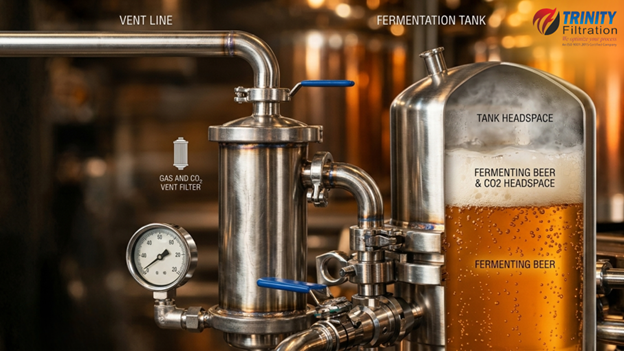
When beer is pumped out of fermentation or conditioning tanks, a vacuum is created. Without a sterile vent filter, non-sterile cleanroom or ambient cellar air is sucked into the headspace, contaminating the tank. Trinity sanitary vent filter housings with hydrophobic 0.2 µm PTFE cartridges provide an absolute barrier against airborne micro-organisms while equalizing pressure safely.
Stage 4: Post-Fermentation Yeast & Trub Trap Filtration
After primary fermentation and cold crashing, beer transferred from conical fermenters contains yeast plugs and hop trub. A high dirt-capacity depth trap filter (such as Micro-STRING Wound or Spun-BOND 10 µm - 20 µm) intercepts bulk solids, protecting expensive downstream clarification modules from premature blinding.
Stage 5: Clarification & Haze Reduction (DE-Free Modern Filtration)
Traditional diatomaceous earth (DE / Kieselguhr) filters present severe operator respiratory health hazards (silicosis) and generate messy hazardous waste cakes. Modern breweries have standardized on Charge-Plus Lenticular Depth Filter Modules enclosed in sanitary SS 316L housings:
- Positively charged media sheets capture negatively charged yeast cells and colloidal haze particles via electrokinetic adsorption.
- Enclosed design guarantees zero beer oxidation (DO pickup < 5 ppb), 100% hygienic CIP regeneration, and up to 30 backwash cycles.
Stage 6: Final Cold Sterile Membrane Filtration for Bottling
Thermal tunnel or flash pasteurization degrades delicate hop aromatics, caramelizes residual sugars, and consumes massive thermal energy. Cold Sterile Filtration using 0.45 µm hydrophilic PES membrane cartridges (SteriPro PE) provides an absolute physical barrier against spoilage organisms without heating:
- Validated titer reduction: complete retention of Saccharomyces cerevisiae, Lactobacillus brevis, and Pediococcus damnosus.
- Preserves crisp hop character, fresh aroma, and head retention proteins while delivering extended 12-month ambient shelf life.
Stage 7: CIP Verification and Integrity Testing
Membrane filters must be integrity tested (Forward Flow Diffusion or Bubble Point) using automated test units before and after every packaging run. This provides ironclad documentation verifying that the sterile barrier was intact throughout the entire bottling batch.