
Executive Summary & Key Takeaways
- Precious metal catalysts (platinum, palladium, rhodium, ruthenium) and Raney nickel represent tens of thousands of dollars per batch; uncaptured fines destroy plant economics.
- Sintered porous SS 316L and Hastelloy C-276 candle filters allow high-temperature, high-pressure slurry recovery with full backwash cake discharge.
- Automated catalyst recovery skid systems achieve 99.9% catalyst retention, eliminate operator exposure to pyrophoric solids, and pay for themselves in 3 to 6 months.
1. The Strategic and Economic Role of Industrial Catalysts
Catalysts are the unsung engines of modern industrial chemistry. By accelerating reaction rates, lowering activation energy thresholds, and dramatically increasing chemical selectivity, catalysts enable reactions that would otherwise require extreme temperatures or remain economically unfeasible.
From fluidized catalytic cracking (FCC) in petroleum refineries to catalytic hydrogenation in pharmaceutical active pharmaceutical ingredient (API) synthesis, catalysts define plant yields. However, many high-performance catalysts rely on precious noble metals—including Platinum (Pt), Palladium (Pd), Rhodium (Rh), Ruthenium (Ru), or pyrophoric base metals like Raney Nickel. At spot prices exceeding thousands of dollars per troy ounce, losing even minor fractions of catalyst fines downstream represents devastating operational losses.
"In fine chemical and pharmaceutical synthesis, unrecovered catalyst fines that escape reactor loops not only squander tens of thousands of dollars in noble metal value per batch, but they also contaminate downstream APIs, causing multi-million dollar product rejections."
2. What Is an Industrial Catalyst Recovery Filter?
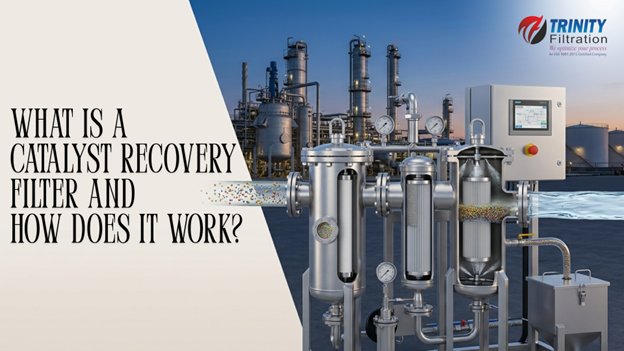
A catalyst recovery filter is a heavy-duty, pressure-rated filtration skid engineered to capture sub-micron catalyst particulates directly from reactor discharge slurries under extreme operating temperatures, aggressive pressures, and harsh chemical environments.
Unlike disposable cartridge systems where elements are discarded after single use, an engineered catalyst recovery system features permanent, cleanable porous media (such as sintered porous metal or Hastelloy candle elements) integrated with automated backwashing and cake discharge mechanisms.
Core Engineering Objectives:
- Quantitative Catalyst Reclamation: Capturing ≥ 99.9% of catalyst particles down to 0.5 µm to allow chemical reactivation or direct slurry recycling back into the reactor.
- Downstream Protection: Ensuring reactor effluent is completely free of abrasive catalyst fines before entering distillation columns, pumps, or crystallization vessels.
- Pyrophoric Safety & Operator Protection: Spent catalysts (especially Raney nickel and Pd/C) are spontaneously combustible (pyrophoric) upon air exposure. A closed-loop automated recovery skid eliminates manual filter opening and protects operators from toxic fumes and flash fires.
3. Key Filter Media and System Metallurgy
| Filter Media Type | Construction Material | Operating Limits | Best Suited Applications |
|---|---|---|---|
| Meta-PORE Sintered Metal | SS 316L, 316Ti, Hastelloy C-276, Inconel | Up to 450°C, 35 bar ΔP | Hydrogenation reactors, hot solvent loops, aggressive acid slurries |
| Porous Metal Candle Elements | Seamless Sintered Porous SS 316L Tubes | Reverse pulse backwash capable | Continuous batch cake filtration with automated gas pulse cake drop |
| High-Temperature Pleated Mesh | Stainless Steel 316L Wire Cloth | High surface area, low clean ΔP | FCC catalyst fines in petroleum refining, gasification syngas |
| Fluoro-Polymer Membranes | All-Fluoropolymer PTFE / PVDF | Up to 150°C, extreme pH 0 - 14 | Corrosive chlorination catalysts, specialty fine chemicals |
4. Operating Cycle of an Automated Recovery Skid
A complete automated Trinity Catalyst Recovery Skid operates in five sequential, PLC-controlled phases:
- Slurry Filtration & Cake Deposition: Reactor slurry enters the pressure vessel. As clear filtrate discharges through the core, catalyst particles build a uniform, highly permeable cake layer across the outer surface of the sintered candle tubes.
- Cake Washing: Clean solvent is pumped through the vessel to displace valuable chemical reaction product from the porous cake voids, boosting overall product yield.
- Gas Blowback & Drying: High-pressure inert gas (Nitrogen N2) blows through the cake, purging residual liquid until the catalyst cake reaches a low moisture percentage.
- Reverse Pulse Cake Discharge: A rapid, high-pressure nitrogen pulse is directed into the clean interior of the candle tubes in reverse direction, instantly dislodging the catalyst cake. The concentrated solids drop through the bottom conical discharge port back into a slurry tank or transport drum.
- In-Situ CIP Regeneration: The vessel undergoes hot chemical backflushing to restore clean baseline differential pressure before the next reactor batch cycle begins.
5. Economic Payback Analysis: Hydrogenation ROI
Consider a fine chemical plant operating a 5,000-liter batch hydrogenation reactor using 5% Palladium on Carbon (Pd/C) catalyst at a concentration of 0.5% weight:
- Monthly Catalyst Processing: 150 kg of 5% Pd/C (~7.5 kg of pure palladium metal).
- Without Sintered Metal Recovery: Conventional plate presses allow 2% to 4% fine loss during changeouts and washing (~225 grams of Pd lost per month, equivalent to ~$7,500/month).
- With Trinity Closed-Loop Catalyst Skid: Retention efficiency reaches 99.95%, recovering over $85,000 annually in precious metals while cutting manual labor changeout time from 4 hours to 0 hours.
The total capital investment in the recovery skid typically achieves 100% financial payback within 4 to 8 months of commissioning.