
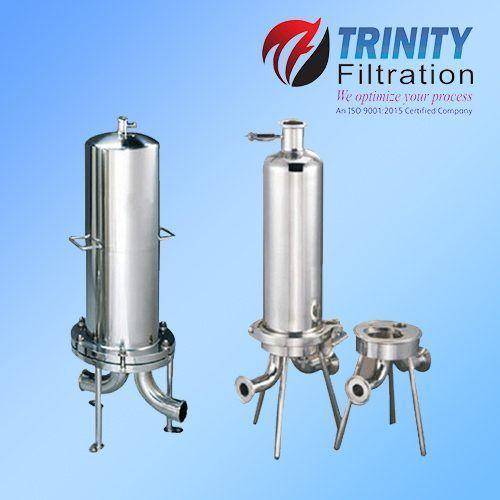
Trinity Engineering Whitepaper
Executive Summary & Key Takeaways
- Electropolished 316L stainless steel with surface roughness Ra ≤ 0.38 µm (15 µin) minimizes bacterial adhesion.
- True sanitary design mandates zero dead-legs (L/D < 2) and minimum 0.5° housing base slope for 100% self-draining CIP.
- Ferrite content in contact wetted parts must be strictly controlled below 1% to eliminate rouge formation in hot WFI.
1. The Importance of ASME BPE Material Metallurgy
Standard industrial grade SS 304 or uncertified 316 stainless steels are susceptible to pitting corrosion and micro-crack rouge formation in aggressive clean-in-place (CIP) chemicals like hot sodium hydroxide and nitric acid. ASME BPE specifies low-carbon SS 316L (UNS S31603) with sulfur content strictly bounded between 0.005% and 0.017% for optimal orbital welding consistency.
2. Surface Finish Classifications (SF1 vs SF4)
| BPE Finish Code | Surface Treatment | Maximum Roughness (Ra) | Application Level |
|---|---|---|---|
| SF1 | Mechanical Polish Only | Ra ≤ 0.51 µm (20 µin) | Buffer prep, utility gas, CIP drain lines |
| SF4 | Mechanical Polish + Electropolish | Ra ≤ 0.38 µm (15 µin) | Sterile drug filling, WFI distribution, fermenters |
| SF5 | High Precision Electropolish | Ra ≤ 0.25 µm (10 µin) | Ultra-pure biologics, vaccines, injectable APIs |
3. Self-Draining Geometry & Zero Dead-Legs
In accordance with ASME BPE SD-3.1.2.2, vessel heads and base drain outlets must feature inverted spherical or conical profiles sloped at a minimum of 0.5 degrees toward the sanitary tri-clamp drain port. This guarantees complete gravity evacuation without liquid pooling after steam sterilization (SIP).